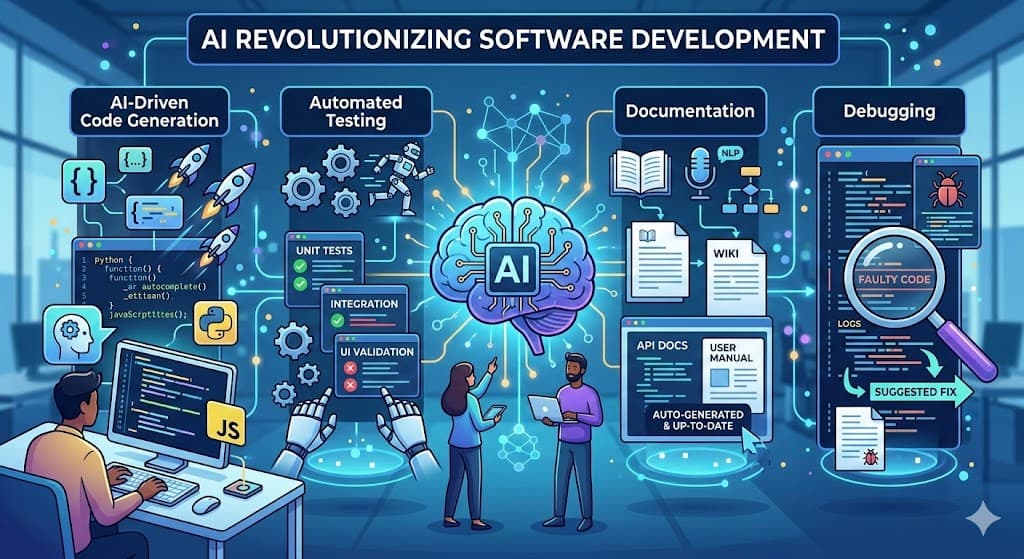

AI-Driven Development: The Rise of the AI Co-Pilot
The software development landscape is undergoing a seismic shift. Forget tedious debugging and endless documentation – Artificial Intelligence (AI) is no longer just a tool for developers; it's becoming a partner. We're entering the era of AI-Driven Development, where AI co-pilots are assisting in every stage of the software lifecycle, from initial code generation to final deployment and maintenance.
The AI Revolution in Code:
The most visible aspect of AI-Driven Development is AI-powered code generation. Tools like GitHub Copilot, powered by OpenAI Codex, can analyze code context and automatically suggest entire blocks of code, functions, and even complete programs. This isn't just autocompletion on steroids; it's intelligent code synthesis, learning from billions of lines of code to provide relevant and contextually accurate suggestions. This dramatically reduces coding time and allows developers to focus on higher-level design and architectural considerations.
Beyond Code Generation: A Full-Lifecycle Partner
AI's impact extends far beyond just writing code. Consider these applications:
- Automated Testing: AI can automatically generate test cases based on code analysis, identify potential edge cases, and even write the tests themselves. This drastically reduces the burden of manual testing and improves code quality.
- AI-Powered Debugging: AI can analyze code for potential bugs, identify root causes, and even suggest fixes. This accelerates the debugging process and reduces the time spent on tedious bug hunts.
- Intelligent Documentation: AI can automatically generate documentation from code, ensuring that documentation is always up-to-date and accurate. This is a huge time-saver and improves code maintainability.
- Smart Refactoring: AI can identify opportunities to refactor code, improve its readability, and reduce its complexity. This leads to more maintainable and robust codebases.
- Security Vulnerability Detection: AI models are increasingly capable of identifying security vulnerabilities in code, helping developers proactively address security risks.
The Benefits are Clear:
The adoption of AI-Driven Development offers several compelling benefits:
- Increased Productivity: AI can automate repetitive tasks, freeing up developers to focus on more creative and strategic work.
- Improved Code Quality: AI can help identify and prevent errors, leading to more robust and reliable code.
- Reduced Development Costs: By automating tasks and improving efficiency, AI can significantly reduce development costs.
- Faster Time to Market: AI can accelerate the development process, allowing companies to bring products to market faster.
- Democratization of Development: AI-assisted tools can lower the barrier to entry for new developers, making it easier to learn and contribute to software projects.
Challenges and Considerations:
While the potential of AI-Driven Development is immense, there are also challenges to consider:
- The "Garbage In, Garbage Out" Problem: AI models are only as good as the data they are trained on. If the training data is biased or incomplete, the AI will produce biased or inaccurate results.
- Over-Reliance on AI: Developers need to maintain their critical thinking skills and not blindly trust AI-generated code. Code generated by AI should always be reviewed and tested thoroughly.
- Ethical Considerations: AI can perpetuate existing biases in code, leading to unfair or discriminatory outcomes. It's important to be aware of these risks and take steps to mitigate them.
- The Evolving Role of the Developer: Developers will need to adapt to a new role, where they are more focused on high-level design, architecture, and problem-solving, and less on writing boilerplate code.
The Future is Now:
AI-Driven Development is not a future trend; it's happening now. As AI models become more sophisticated and accessible, we can expect to see even more widespread adoption of AI in the software development process. Developers who embrace these technologies and adapt to the changing landscape will be well-positioned to thrive in the future.
Deep Dives Similar to This
A comprehensive overview of the current state of microservices architecture, including its benefits, challenges, and future trends, aimed at developers.
Discover the future of software architecture: Multi-Agent AI Orchestration. Learn how to design systems where AI agents act as parallel processors, collaborating to solve complex problems. Explore the essential skills, tools, and technologies to thrive in this new era.
A comprehensive report on Rust, its features, adoption trends, use cases, and its potential to become the new standard in performance and safety.