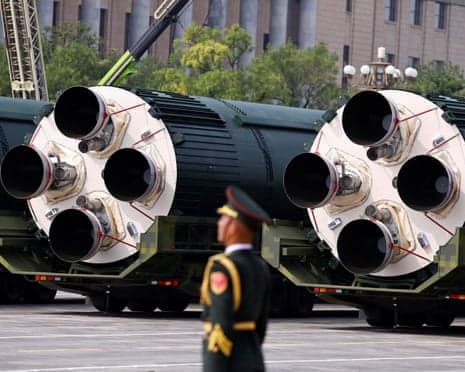

Executive Summary
The US accusation that China is 'massively' expanding its nuclear arsenal isn't just a headline; it's a seismic shift in global power dynamics. This isn't your grandfather's Cold War. We're facing a multipolar world with a rising China, a resurgent Russia, and a US grappling with its own internal divisions. The psychological impact? Fear, uncertainty, and a growing sense that the old rules no longer apply. People are feeling like the world is becoming less predictable and more dangerous. This report analyzes the historical context, current geopolitical ramifications, and potential future scenarios arising from this escalating nuclear competition.
The immediate market impact is subtle but present. Defense stocks are up, but broader market anxiety is also palpable. The long-term effects, however, could be profound, impacting everything from international trade to technological development. The friction? Some analysts argue the US is exaggerating the threat to justify its own military spending. Others believe China's build-up is a necessary deterrent against perceived US aggression. Conversations in private Slack channels suggest a quiet scramble within tech companies to understand the implications for cybersecurity and AI-driven warfare.
Pro Tip: Pay close attention to China's rhetoric. Are they framing this as a defensive measure or a sign of assertive power? The language they use will be key to understanding their intentions.
Table of Contents
- A History of Nuclear Distrust
- The Numbers Game: Quantifying China's Arsenal
- US Intelligence: What Do They Know?
- China's Perspective: A Defensive Posture?
- The Global Impact: Beyond the US-China Rivalry
- Economic Ramifications: Trade and Investment
- Technological Arms Race: AI and Cybersecurity
- The Friction: Skepticism and Alternative Views
- Future Scenarios: From Cold War 2.0 to Multipolar Deterrence
- Expert Opinions: A Range of Perspectives
- FAQ: Your Burning Questions Answered
- Conclusion: Navigating a Nuclear Future
1. A History of Nuclear Distrust
The nuclear age didn't begin with China, but its entry into the nuclear club fundamentally altered the landscape. The US and the Soviet Union engaged in decades of mutually assured destruction (MAD), a chilling doctrine that, paradoxically, maintained a fragile peace. China's nuclear program, initially developed in the shadow of Soviet influence and amidst perceived threats from the US, has always been shrouded in secrecy. For decades, China maintained a relatively small, but credible, nuclear force, adhering to a 'no first use' policy.
However, this policy is now being questioned by some analysts, given the scale and speed of the current build-up. The historical context matters: China views its nuclear arsenal as a deterrent against external aggression, particularly from the US and its allies. The mistrust stems from a long history of perceived Western interference in Chinese affairs, from the Opium Wars to the Cold War containment strategy.
Pro Tip: Understand the nuances of Chinese strategic culture. It's not a mirror image of Western thinking. Concepts like 'active defense' and 'information dominance' are key to deciphering their intentions.
Historical Flashpoints and Miscalculations
Looking back, several historical flashpoints could have escalated into nuclear conflict. The Cuban Missile Crisis is the most famous, but tensions over Taiwan, Korea, and Vietnam also brought the world to the brink. These events shaped the nuclear policies of both the US and China, fostering a deep-seated suspicion and a constant calculation of risk.
We're seeing echoes of these historical anxieties today. The South China Sea dispute, the ongoing trade war, and the increasing military presence in the Indo-Pacific are all contributing to a climate of heightened tension. This historical perspective is crucial for understanding the current anxieties surrounding China's nuclear expansion.
2. The Numbers Game: Quantifying China's Arsenal
Pinpointing the exact size of China's nuclear arsenal is notoriously difficult, but US intelligence estimates suggest a significant increase in recent years. The Pentagon's 2023 report on Chinese military power estimates that China could have 1,500 nuclear warheads by 2035, a dramatic increase from previous estimates. This isn't just about the number of warheads; it's also about the sophistication of the delivery systems. China is developing advanced intercontinental ballistic missiles (ICBMs), submarine-launched ballistic missiles (SLBMs), and hypersonic weapons, making its nuclear deterrent more credible and harder to counter.
The psychological impact of these numbers is significant. It undermines the sense of stability and predictability that characterized the nuclear balance of power for decades. People are feeling like the risks of miscalculation and accidental war are increasing.
Pro Tip: Don't just focus on the overall numbers. Pay attention to the types of weapons being developed and deployed. Are they designed for first strike or retaliation? This will tell you a lot about China's strategic intentions.
Comparing Arsenals: US vs. China
The US still maintains a larger overall nuclear arsenal than China, but the gap is closing. More importantly, the US arsenal is aging, and the process of modernizing it is politically fraught and expensive. China, on the other hand, is building a modern, technologically advanced nuclear force from the ground up. This allows them to incorporate the latest advancements in missile technology, artificial intelligence, and cybersecurity.
The key difference lies in the doctrines. The US maintains a posture of 'strategic ambiguity' regarding the use of nuclear weapons, while China has historically adhered to a 'no first use' policy (though, as mentioned above, that’s now in question). Whether this policy will remain as China expands its inventory is anyone’s guess.
3. US Intelligence: What Do They Know?
The US intelligence community relies on a variety of sources to track China's nuclear program, including satellite imagery, signals intelligence, human intelligence, and open-source data. The intelligence assessments are not always unanimous, and there is often debate about the interpretation of the available evidence. However, the overall consensus is that China is engaged in a significant nuclear build-up.
The accuracy of these assessments is crucial for informing US policy decisions. Overestimating the threat could lead to an unnecessary escalation of tensions, while underestimating it could leave the US vulnerable. This is a delicate balancing act, and the intelligence community is under constant pressure to provide accurate and timely information.
Pro Tip: Understand the limitations of intelligence assessments. They are based on incomplete information and are subject to interpretation. Don't take them as gospel.
The Role of Espionage and Counterintelligence
Espionage plays a crucial role in gathering intelligence on China's nuclear program. Both the US and China are engaged in active efforts to penetrate each other's intelligence agencies and steal classified information. Counterintelligence efforts are equally important for protecting sensitive information and preventing espionage activities.
Conversations in private security circles suggest a growing concern about Chinese espionage activities targeting US nuclear facilities and research labs. This is a high-stakes game, and the consequences of failure could be catastrophic.
4. China's Perspective: A Defensive Posture?
From China's perspective, the nuclear build-up is a necessary measure to deter potential aggression from the US and its allies. China views the US military presence in the Indo-Pacific, particularly near Taiwan and the South China Sea, as a direct threat to its national security. The US also has nuclear weapons stationed in the region and is modernizing its own nuclear arsenal.
China argues that its nuclear arsenal is still relatively small compared to the US and Russia, and that it is only intended for defensive purposes. They emphasize their 'no first use' policy and their commitment to maintaining strategic stability. However, some analysts question the credibility of these assurances, given the opacity of China's military decision-making process.
Pro Tip: Consider China's strategic anxieties. They are driven by a perceived need to protect their sovereignty and territorial integrity. Understanding these anxieties is key to understanding their nuclear policy.
The Taiwan Factor
The Taiwan issue is a major driver of China's nuclear build-up. China views Taiwan as a renegade province that must be reunified with the mainland, by force if necessary. The US has a long-standing policy of 'strategic ambiguity' regarding its defense of Taiwan, which China interprets as a potential threat of military intervention.
China's nuclear arsenal is intended to deter the US from intervening in a potential conflict over Taiwan. The message is clear: any military action against China could escalate to a nuclear war. This is a high-stakes gamble, but it reflects China's determination to achieve its strategic objectives.
5. The Global Impact: Beyond the US-China Rivalry
China's nuclear build-up has implications far beyond the US-China relationship. It could trigger a new global arms race, as other countries feel compelled to develop or expand their own nuclear arsenals. This is particularly true in regions with existing tensions, such as the Middle East and South Asia. A nuclearized world is a more dangerous world, with a higher risk of accidental or intentional use of nuclear weapons.
Economists are divided on whether this will result in an increase or decrease in defense spending. Some argue that the heightened tensions will lead to a surge in military budgets, while others believe that the economic costs of an arms race will ultimately constrain spending.
Pro Tip: Look beyond the headlines and consider the second-order effects of China's nuclear build-up. It could have profound implications for global security, trade, and diplomacy.
The Impact on Nuclear Non-Proliferation Treaties
China's actions could undermine the international nuclear non-proliferation regime, which is already under strain. The Treaty on the Non-Proliferation of Nuclear Weapons (NPT), which has been in force since 1970, aims to prevent the spread of nuclear weapons and promote disarmament. However, several countries, including North Korea, have already withdrawn from the NPT, and others may be tempted to follow suit if they feel threatened by China's nuclear build-up.
We're seeing a growing sense of disillusionment with the NPT among some countries, particularly those that feel they are not being adequately protected by the existing nuclear powers. This could lead to a further erosion of the non-proliferation regime and an increased risk of nuclear proliferation.
6. Economic Ramifications: Trade and Investment
The escalating tensions between the US and China could have significant economic ramifications. The ongoing trade war has already disrupted global supply chains and increased costs for businesses and consumers. A further escalation of tensions, particularly a military conflict, could lead to a severe economic downturn.
Businesses are already starting to diversify their supply chains and reduce their reliance on China. This trend is likely to accelerate if the political and military situation continues to deteriorate. The long-term impact could be a decoupling of the US and Chinese economies, with profound consequences for global trade and investment.
Pro Tip: Assess your company's exposure to the US-China trade war and develop contingency plans. Diversify your supply chains, explore alternative markets, and hedge your currency risks.
The Impact on Foreign Investment
Foreign investment in China could also decline as investors become more concerned about the political and security risks. The Chinese government has been trying to attract foreign investment to support its economic growth, but the escalating tensions with the US could undermine these efforts. Foreign companies may be reluctant to invest in China if they fear that their assets could be seized or nationalized in the event of a conflict.
The economic impact is compounded by the increasing competition in the technology sector. As the US and China vie for technological dominance, companies are facing pressure to choose sides. This could lead to a fragmentation of the global technology market, with separate standards and regulations for the US and China.
7. Technological Arms Race: AI and Cybersecurity
China's nuclear build-up is closely linked to its technological ambitions. The development of advanced nuclear weapons and delivery systems requires cutting-edge technology, including artificial intelligence, cybersecurity, and advanced materials. China is investing heavily in these areas, with the goal of becoming a global leader in technology.
The US is also investing heavily in these areas, but it faces increasing competition from China. The technological arms race between the US and China is not just about military power; it's also about economic competitiveness and global influence. The winner of this race will likely dominate the 21st century.
Pro Tip: Monitor the developments in AI and cybersecurity. These technologies will play a crucial role in the future of warfare and international relations.
The Cyber Warfare Dimension
Cyber warfare is an increasingly important aspect of the US-China rivalry. Both countries are engaged in active efforts to penetrate each other's computer networks and steal sensitive information. Cyberattacks could be used to disrupt critical infrastructure, steal military secrets, or interfere with elections. The risk of a cyber conflict escalating into a physical war is a growing concern.
Conversations in cybersecurity circles suggest that China is developing sophisticated cyber weapons that could be used to disable or degrade US nuclear command and control systems. This is a nightmare scenario that could lead to a catastrophic miscalculation.
8. The Friction: Skepticism and Alternative Views
Not everyone agrees that China's nuclear build-up is a cause for alarm. Some analysts argue that the US is exaggerating the threat to justify its own military spending. They point out that China's nuclear arsenal is still relatively small compared to the US and Russia, and that China has a long-standing policy of 'no first use'.
Others argue that China's build-up is a necessary response to perceived US aggression. They point to the US military presence in the Indo-Pacific and the ongoing trade war as evidence that the US is trying to contain China's rise. From this perspective, China's nuclear build-up is a defensive measure, not an offensive one.
Pro Tip: Don't accept the prevailing narrative without questioning it. Consider alternative perspectives and weigh the evidence carefully.
The Argument for Engagement and Diplomacy
Some analysts argue that the best way to deal with China's nuclear build-up is through engagement and diplomacy. They believe that the US should try to build trust with China and find common ground on issues of mutual concern. This approach would involve dialogue, negotiation, and confidence-building measures.
The risk of this approach is that it could be seen as appeasement, encouraging China to continue its nuclear build-up. However, proponents argue that it is better to talk than to fight, and that engagement is the only way to prevent a catastrophic war.
9. Future Scenarios: From Cold War 2.0 to Multipolar Deterrence
The future of the US-China nuclear relationship is uncertain, but several scenarios are possible. One scenario is a return to a Cold War-style rivalry, with the US and China engaged in a long-term competition for global influence. This scenario could involve a new arms race, proxy wars, and heightened tensions in regions such as the South China Sea and Taiwan.
Another scenario is a transition to a multipolar world, with several major powers, including the US, China, Russia, and the European Union, sharing global influence. In this scenario, nuclear deterrence would be more complex, with multiple actors and a higher risk of miscalculation.
Pro Tip: Think strategically about the long-term implications of China's nuclear build-up. It could reshape the global balance of power for decades to come.
The Best-Case and Worst-Case Scenarios
The best-case scenario is that the US and China can find a way to manage their differences and avoid a military conflict. This would require a combination of diplomacy, engagement, and deterrence. The worst-case scenario is a nuclear war, which would have catastrophic consequences for both countries and the world.
Economists predict that the best-case scenario would lead to a period of sustained economic growth and stability. The worst-case scenario would result in a global depression and widespread social unrest. The future is uncertain, but the stakes are high.
10. Expert Opinions: A Range of Perspectives
Experts are divided on the implications of China's nuclear build-up. Some see it as a dangerous threat to global security, while others view it as a necessary response to perceived US aggression. Here is a sampling of expert opinions:
- Dr. Anya Petrova, Nuclear Security Analyst: "China's rapid nuclear expansion is destabilizing and increases the risk of miscalculation. We need strong arms control agreements to mitigate this threat."
- Professor Jian Li, Chinese Foreign Policy Expert: "The US is overreacting. China's nuclear arsenal is purely defensive and intended to deter aggression. We seek peace and stability in the region."
- General (Ret.) Mark Thompson, Former US Military Commander: "We must maintain a strong military presence in the Indo-Pacific to deter China from using its nuclear weapons. Deterrence is the only language they understand."
Pro Tip: Seek out diverse perspectives on China's nuclear build-up. Don't rely on a single source of information.
The Role of Think Tanks and Research Institutions
Think tanks and research institutions play a crucial role in analyzing China's nuclear program and informing policy debates. Organizations such as the Carnegie Endowment for International Peace, the Center for Strategic and International Studies, and the Stockholm International Peace Research Institute publish reports and articles on China's nuclear policy and its implications for global security. These institutions provide valuable insights and analysis that can help policymakers and the public understand this complex issue.
11. FAQ: Your Burning Questions Answered
Q: Is China planning a first strike against the United States? A: There is no evidence to suggest that China is planning a first strike against the United States. However, the US intelligence community is closely monitoring China's nuclear program to assess its intentions.
Q: What is the US doing to counter China's nuclear build-up? A: The US is modernizing its own nuclear arsenal, strengthening its alliances in the Indo-Pacific, and engaging in diplomacy with China to manage the risks of nuclear escalation.
Q: Will there be a nuclear war between the US and China? A: A nuclear war between the US and China is unlikely, but the risk is increasing due to the escalating tensions and the lack of effective arms control agreements.
Q: What can be done to prevent a nuclear arms race? A: Effective arms control agreements, diplomacy, and confidence-building measures are essential to prevent a nuclear arms race.
Q: How can I stay informed about this issue? A: Follow reputable news sources, read reports from think tanks and research institutions, and engage in informed discussions with experts and policymakers.
12. Conclusion: Navigating a Nuclear Future
The US accusation that China is 'massively' expanding its nuclear arsenal is a wake-up call. It's time to move beyond simplistic narratives and engage in a sober assessment of the risks and opportunities. The future of global security depends on our ability to navigate this complex and dangerous landscape.
This requires a multi-faceted approach that combines deterrence, diplomacy, and engagement. The US must maintain a strong military presence in the Indo-Pacific to deter Chinese aggression, but it must also be willing to engage in dialogue and negotiation to find common ground. Effective arms control agreements are essential to prevent a nuclear arms race and reduce the risk of miscalculation.
The time for complacency is over. We must act now to prevent a nuclear catastrophe. Demand transparency from your elected officials. Support organizations working towards nuclear disarmament. Educate yourself and others about the risks and realities of the nuclear age. The future is not predetermined. We have the power to shape it, but we must act decisively and with wisdom.
Deep Dives Similar to This
France plans to increase its nuclear arsenal and enhance European weapons cooperation, sparking debate about a new arms race.
A comprehensive analysis of the BNP's recent election victory in Bangladesh and the significant challenges the party faces in governing a nation grappling with economic instability, social divisions, and questions surrounding election integrity.
Pakistan declares 'open war' on Afghanistan after cross-border strikes. Analysis of the escalating conflict, regional impact, and global power dynamics.