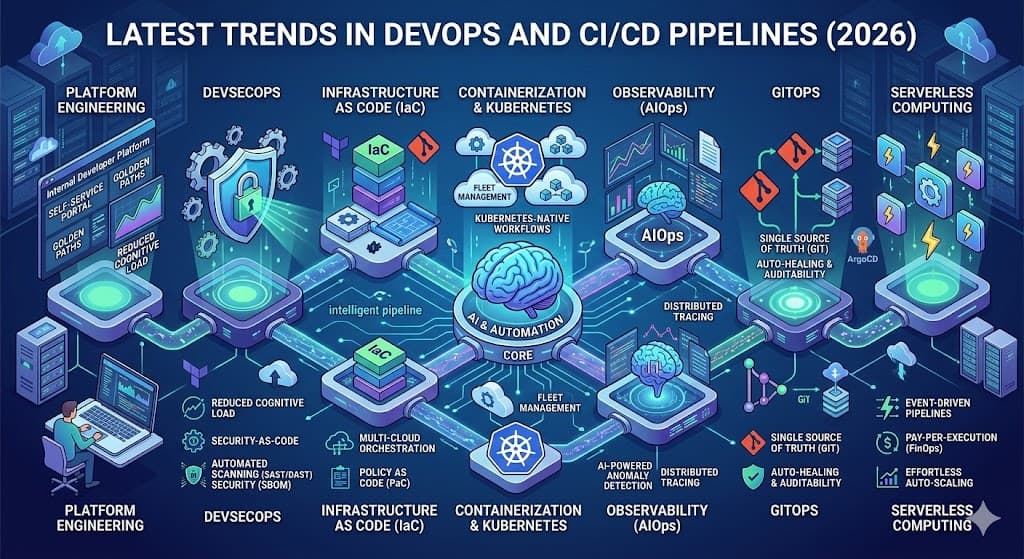

DevOps & CI/CD Pipelines: The Automation Imperative (2024 Trend Report)
In today's hyper-competitive software landscape, shipping features quickly and reliably is no longer a 'nice-to-have' but a fundamental requirement for survival. DevOps practices and CI/CD pipelines are the engines driving this continuous software innovation, enabling teams to automate the software development lifecycle from code commit to deployment and beyond.
This report dives deep into the current state and future trends of DevOps and CI/CD, highlighting key technologies, emerging practices, and the challenges and opportunities that lie ahead.
The Rise of Platform Engineering
One of the most significant trends is the emergence of Platform Engineering. Developers need self-service capabilities. Platform engineering is all about building and operating a self-service internal developer platform (IDP) that reduces the cognitive load on developers by providing pre-configured, standardized, and automated tooling. This allows developers to focus on writing code and shipping features, rather than wrestling with infrastructure and complex configurations. Expect to see a surge in companies adopting platform engineering practices to boost developer productivity and accelerate delivery cycles.
- Key Technologies: Backstage, Crossplane, Terraform, Kubernetes, Argo CD.
- Viral Take: If you're not building an IDP, you're likely losing developer productivity (and money!).
Security Baked In: DevSecOps is Non-Negotiable
Security can't be an afterthought. DevSecOps shifts security left, integrating security practices throughout the entire CI/CD pipeline. Automated security scans, vulnerability assessments, and compliance checks are becoming standard practice. The cost of a security breach far outweighs the investment in proactive security measures.
- Key Technologies: Snyk, SonarQube, Checkmarx, Aqua Security, Anchore.
- Viral Take: Ship secure code or ship nothing at all. DevSecOps is the only way to build trust and maintain a strong security posture.
Infrastructure as Code (IaC) Gets Smarter
Infrastructure as Code (IaC) has revolutionized infrastructure management, enabling teams to define and manage infrastructure through code. However, IaC is evolving beyond basic provisioning. We're seeing a move towards more intelligent IaC, with features like automated drift detection, policy enforcement, and self-healing capabilities.
- Key Technologies: Terraform, AWS CloudFormation, Azure Resource Manager, Pulumi.
- Viral Take: IaC is no longer just about provisioning; it's about managing the entire lifecycle of your infrastructure with intelligence and automation.
The Containerization and Orchestration Revolution Continues
Containers (Docker) and Orchestration (Kubernetes) remain foundational technologies for modern DevOps and CI/CD. Kubernetes adoption continues to grow, with a focus on simplifying management and improving scalability. Service meshes like Istio and Linkerd are becoming increasingly important for managing microservices architectures.
- Key Technologies: Docker, Kubernetes, Istio, Linkerd, Helm.
- Viral Take: If you're not containerizing your applications and orchestrating them with Kubernetes, you're missing out on significant efficiency and scalability gains.
Observability: Monitoring and Understanding Complex Systems
As systems become more distributed and complex, observability becomes crucial. Comprehensive monitoring, logging, and tracing are essential for understanding system behavior, identifying performance bottlenecks, and quickly resolving issues. We're seeing a shift towards more proactive observability, with AI-powered tools that can automatically detect anomalies and predict potential problems.
- Key Technologies: Prometheus, Grafana, Jaeger, Datadog, New Relic, Splunk.
- Viral Take: You can't fix what you can't see. Invest in observability to gain deep insights into your systems and ensure reliability.
The Rise of GitOps
GitOps leverages Git as the single source of truth for infrastructure and application deployments. Changes are made through pull requests, providing a clear audit trail and enabling automated rollbacks. GitOps promotes consistency, repeatability, and security in deployments.
- Key Technologies: Argo CD, Flux, Jenkins X.
- Viral Take: GitOps: because who wants to debug deployments at 3 AM? Sleep soundly knowing your infrastructure is managed through Git.
Serverless Computing: The Ultimate Abstraction
Serverless computing offers the ultimate abstraction, allowing developers to focus solely on writing code without worrying about infrastructure management. Serverless architectures are becoming increasingly popular for event-driven applications and microservices. While it adds complexity, for simple, highly scalable applications, it makes sense.
- Key Technologies: AWS Lambda, Azure Functions, Google Cloud Functions, Knative.
- Viral Take: Serverless: Where you don't manage servers, and your cloud provider smiles all the way to the bank (just kidding… mostly!).
Challenges and Opportunities
While DevOps and CI/CD offer significant benefits, there are also challenges to overcome. These include:
- Complexity: Managing complex pipelines and infrastructure can be challenging, especially for large organizations.
- Skills Gap: Finding and retaining skilled DevOps engineers is a major challenge.
- Cultural Shift: Implementing DevOps requires a significant cultural shift, which can be difficult to achieve.
- Tooling Sprawl: The sheer number of DevOps tools can be overwhelming.
The opportunities, however, are enormous. By embracing DevOps practices and CI/CD pipelines, organizations can:
- Accelerate Time to Market: Ship features faster and more reliably.
- Improve Software Quality: Reduce bugs and improve overall software quality.
- Increase Efficiency: Automate tasks and free up developers to focus on innovation.
- Enhance Collaboration: Foster better collaboration between development and operations teams.
Conclusion
DevOps and CI/CD are no longer optional; they are essential for success in today's software-driven world. By embracing automation, security, and observability, organizations can unlock the full potential of DevOps and deliver value to their customers faster and more reliably. The future of software development is automated, and the time to embrace DevOps is now. Get ready to ride the wave!
Deep Dives Similar to This
A comprehensive overview of the current state of microservices architecture, including its benefits, challenges, and future trends, aimed at developers.
Discover the future of software architecture: Multi-Agent AI Orchestration. Learn how to design systems where AI agents act as parallel processors, collaborating to solve complex problems. Explore the essential skills, tools, and technologies to thrive in this new era.
A comprehensive report on Rust, its features, adoption trends, use cases, and its potential to become the new standard in performance and safety.